
Full-duplex cooperative cognitive radio networks
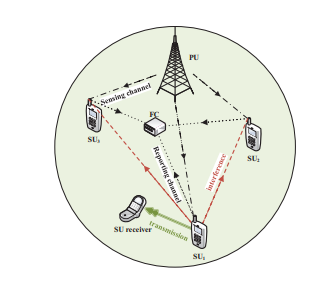
In this paper, we study the impact of a full-duplex secondary node on a cognitive cooperative network with Multipacket Reception (MPR) capabilities at the receivers. Motivated by recent schemes that make full-duplex communication feasible, we study a model with one primary and one secondary transmitter-receiver pair, where the secondary transmitter is able to relay primary unsuccessful packets. Cooperation between primary and secondary users has been previously shown to be beneficial for the primary and the secondary users in terms of stable throughput. Our model assumes an imperfect full
A feedback-soft sensing-based cognitive access scheme with feedback erasures
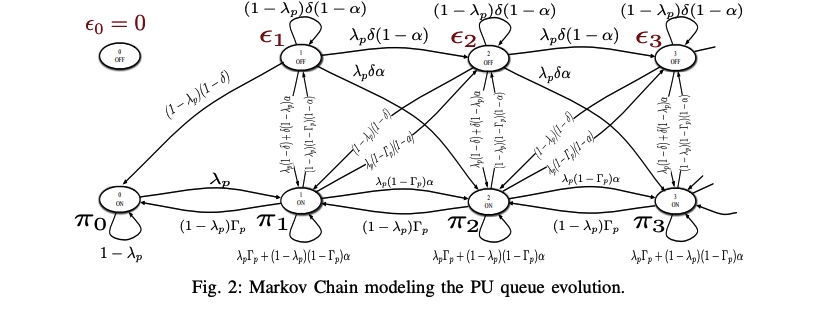
In this paper, we examine a cognitive spectrum access scheme in which a secondary user exploits the primary feedback information. We consider an overlay model in which the secondary user accesses the channel by certain access probabilities that are function of the spectrum sensing metric. In setting our problem, we assume that the secondary user can receive the primary link's feedback automatic repeat request (ARQ), but through an erasure channel. This means that the primary feedback may either be received correctly or is erased with a certain erasure probability. We study the cognitive radio
Non-Orthogonal Multiple Access schemes in Wireless Powered Communication Networks
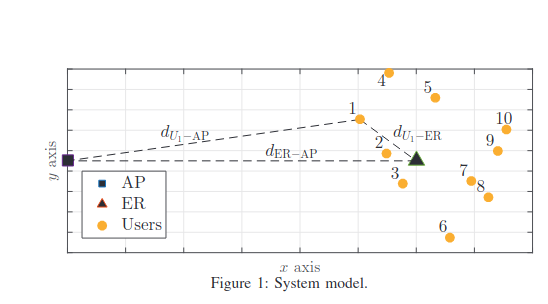
We characterize time and power allocations to optimize the sum-throughput of a Wireless Powered Communication Network (WPCN) with Non-Orthogonal Multiple Access (NOMA). In our setup, an Energy Rich (ER) source broadcasts wireless energy to several devices, which use it to simultaneously transmit data to an Access Point (AP) on the uplink. Differently from most prior works, in this paper we consider a generic scenario, in which the ER and AP do not coincide, i.e., are two separate entities. We study two NOMA decoding schemes, namely Low Complexity Decoding (LCD) and Successive Interference
Odd clipping optical orthogonal frequency division multiplexing for VLC system
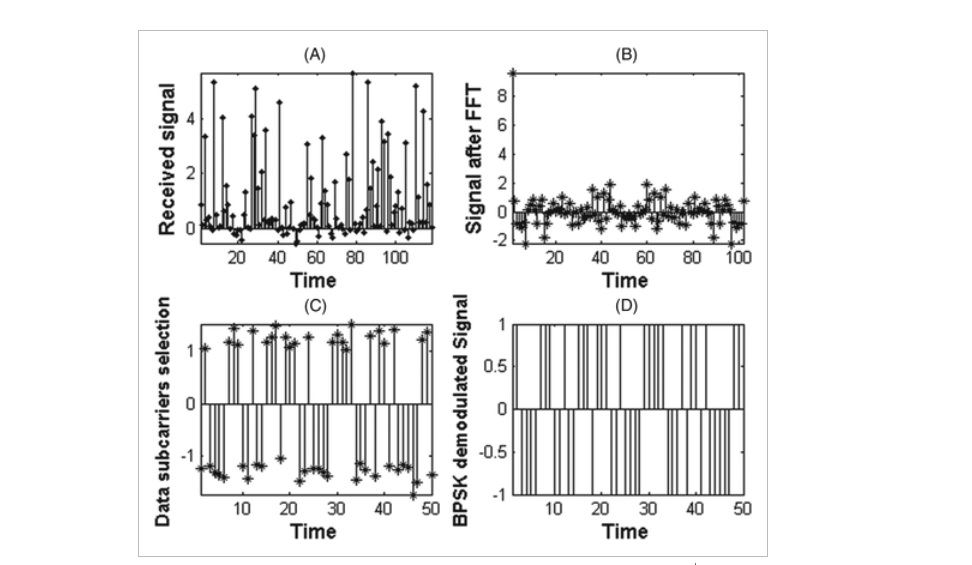
The Orthogonal Frequency Division Multiplexing (OFDM) has emerged as one of the promising techniques because of its robustness to multipath fading with high-speed data transmission. Classical bipolar OFDM cannot be used in intensity modulated with direct detection (IM/DD) optical communication systems, as visible light communication (VLC), so many optical modulation techniques as asymmetrical clipped optical OFDM (ACO-OFDM) and DC-Clipped OFDM (DCO-OFDM) have been investigated. In this paper, we introduce a novel optical modulation scheme that meets the optical communications requirements. The
Joint power allocation and beamforming for multiuser MIMO two-way relay networks
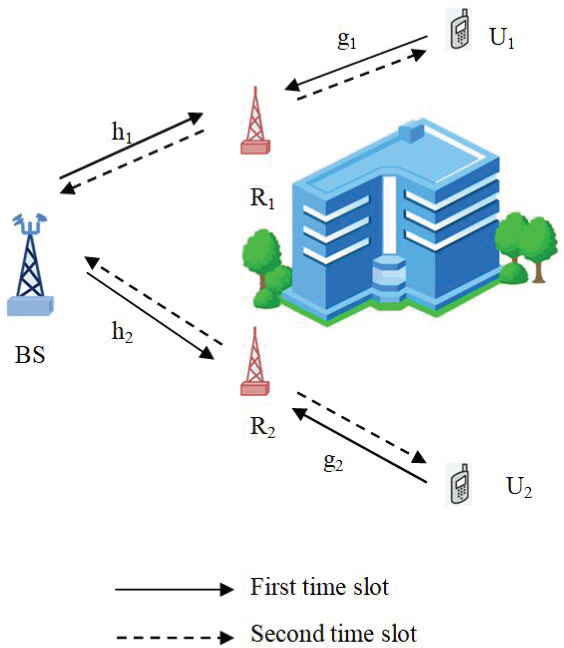
In this paper, a multiuser cellular two-way relaying scenario is considered where multiple single-antenna mobile stations (MSs) and one multiple-antenna base station (BS) communicate, bidirectionally, via one half-duplex multiple-antenna relay station (RS). Furthermore, the case when the number of antennas at the RS is not sufficient to decode the individual messages is addressed. For this case, a two-phase two-way relaying scenario is considered. In the first phase, the multiple access, a minimum Mean Square Error (MSE) optimization problem is formulated which is found to be non-convex. Thus
Content Delivery in Mobility-Aware D2D Caching Networks
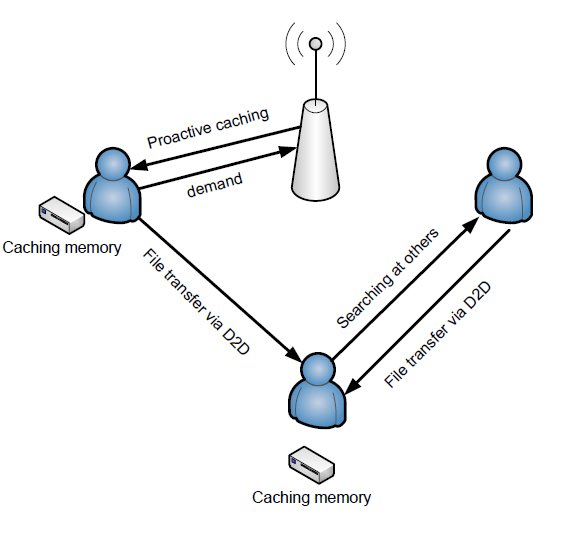
The massive data exchange between base stations and network backhaul creates a strong overhead on mobile networks, especially at peak times. This motivates researchers to think about the proactive caching concept which depends mainly on caching some of the expected data items during off-peak times. The caching problem consists of two distinct phases, placement phase and delivery phase. In this work, we consider a mobility-aware device-to-device (D2D) caching network. We assume that data contents were already cached in users devices during the content placement phase and we focus on the content

Interference-based optimal power-efficient access scheme for cognitive radio networks
In this paper, we propose a new optimization-based access strategy of multi-packet reception (MPR) channel for multiple secondary users (SUs) accessing the primary user (PU) spectrum. We devise an analytical model that realizes the multi-packet access strategy of the SUs. All the network receiving nodes have MPR capability. We aim at maximizing the throughput of the individual SUs subject to the PU's queue stability. Moreover, we are interested in providing an energy-efficient cognitive scheme. Therefore, we include energy constraints on the PU and SU average transmitted energy to the
Towards Extended Bit Tracking for Scalable and Robust RFID Tag Identification Systems
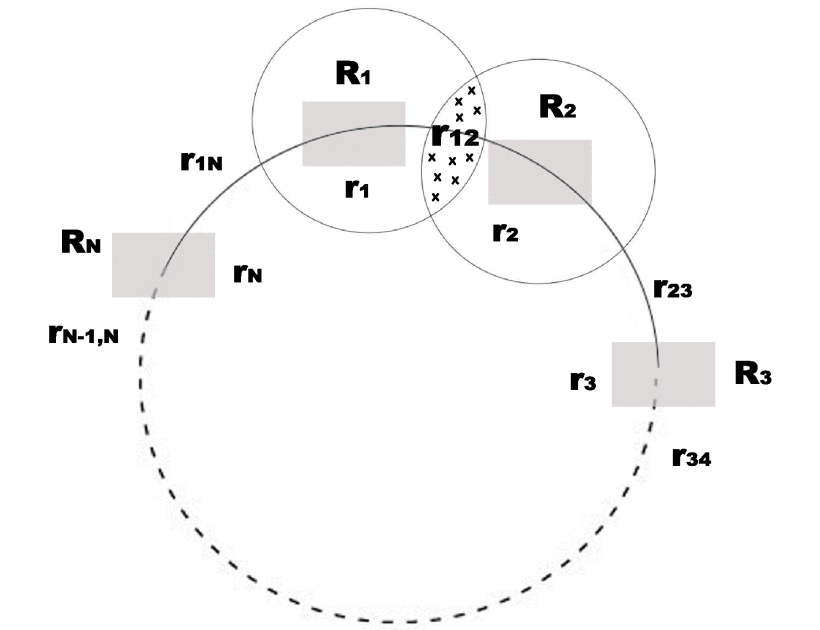
The surge in demand for Internet of Things (IoT) systems and applications has motivated a paradigm shift in the development of viable radio frequency identification technology (RFID)-based solutions for ubiquitous real-Time monitoring and tracking. Bit tracking-based anti-collision algorithms have attracted considerable attention, recently, due to its positive impact on decreasing the identification time. We aim to extend bit tracking to work effectively over erroneous channels and scalable multi RFID readers systems. Towards this objective, we extend the bit tracking technique along two
Authentication over noisy channels
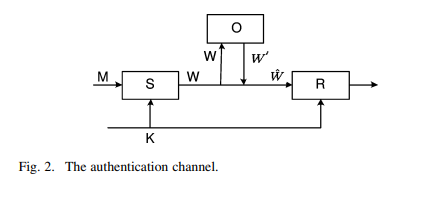
An authentication counterpart of Wyner's study of the wiretap channel is developed in this work. More specifically, message authentication over noisy channels is studied while impersonation and substitution attacks are investigated for both single- and multiple-message scenarios. For each scenario, information-theoretic lower and upper bounds on the opponent's success, or cheating, probability are derived. Remarkably, in both scenarios, the lower and upper bounds are shown to match, and hence, the fundamental limits on message authentication over noisy channels are fully characterized. The
Asymmetrical clipping optical filter bank multi-carrier modulation scheme
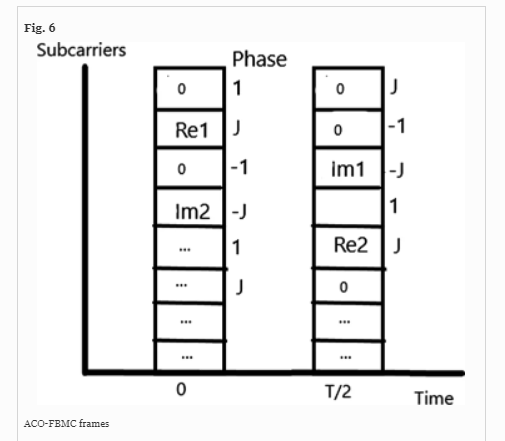
Filter bank multi-carrier (FBMC) is considered a promising alternative to the Orthogonal Frequency Division Multiplexing (OFDM) scheme. It improves spectral efficiency by eliminating the need for cyclic prefix while attenuating interference due to the robustness of the out-of-band emission. In this work, we present a framework, and the performance evaluation of FBMC is a multi-carrier modulation scheme for the direct detection of optical communications. As the proposed model has higher spectral efficiency than the classical ACO-OFDM, as removing the guard interval enhances the spectral