
α -order universal filter realization based on single input multi-output differential voltage current conveyor
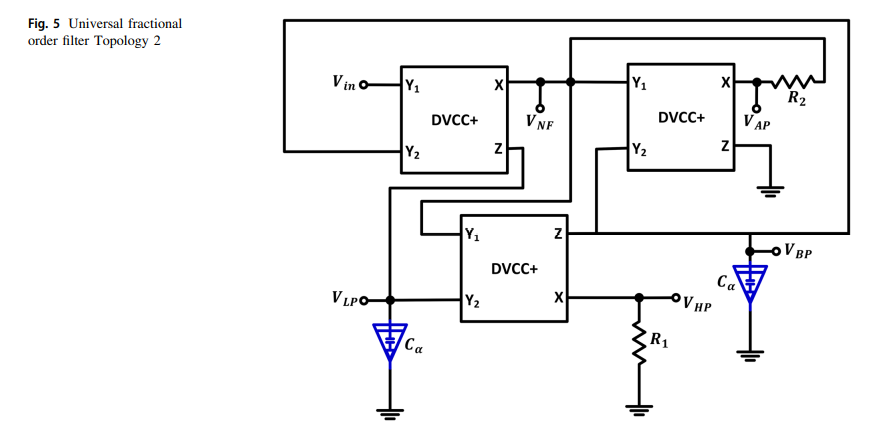
Two voltage-mode topologies single input multi-output universal fractional filters with high input impedance are proposed. The proposed analog filters consist of three DVCC+ blocks, two grounded capacitors and two resistors targeting the minimum passive elements. The proposed topologies provide a realization for all standard fractional filter functions (HP, LP, BP, AP and notch filter). The effect of Fractional order on filter responses in the range of α from 0.7 to 1.2 was studied. Fractional order has been investigated for different filter responses in terms of cutoff, gain, phase and noise
A Stochastic Modeling of the Gain in Waveguide Avalanche Photodetectors (WG-APDs)
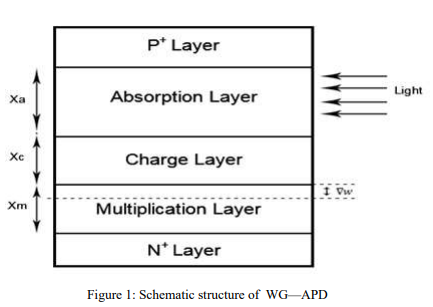
Waveguide photodetectors are considered as a promising candidate for high speed photodetection where the tradeoff between the transit time bandwidth and the quantum efficiency is overcome as the incident optical signal and the photogenerated carriers move in perpendicular directions. In WG-Avalanche Photodetectors (WG-APDs), the avalanche multiplication gain enhances the photocurrent of the photodiodes. In these photodiodes, the inaccuracies in the ionizations coefficients of the photogenerated electrons and holes and in the dimensions of the multiplication layer affect the multiplication gain
J-V characteristics of plasmonic photovoltaics with embedded conical and cylindrical metallic nanoparticles
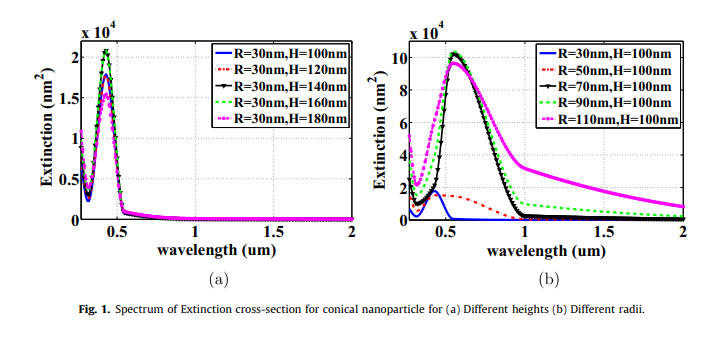
Plasmonic photovoltaics (PVs) are promising structures that improve thin-film photovoltaics performance, where optical absorption is improved via embedding metallic nanoparticles in the PV's active layer to trap the incident optical wave into the photovoltaic cell. The presented work investigates the design of PV with both structures of conical and cylindrical metallic nanoparticles through studying their extinction cross-sections and electric field distributions. Also, the impact of these nanoparticles in silicon PVs on the optical absorption enhancement is investigated. The figure of merit
Polarization Encoded Multi-logic Functions with Direct Detection
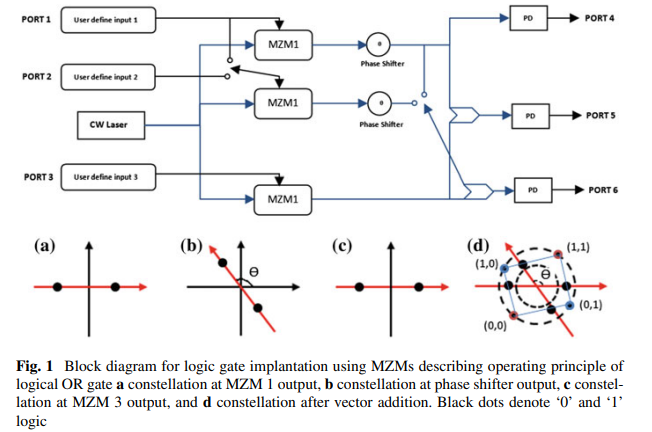
In this paper, a new scheme for the realization of an optical logic circuit using Mach–Zehnder modulators (MZM) with direct detection has been proposed. Amplitude and phase information of the optical signals have been used for the differentiation of optical signals into four different states that can be represented using two binary inputs, while direct detection has been used for the effective mapping of these states with their respective binary outputs. The realization of seven logic gates, two reversible optical logic gates (Feynman and double Feynman gates) and half adder and half
Parametric Analysis of Optical Microring Resonator
This article presents the parametric analysis of the optical microring resonator. It includes the numerically simulated analysis. The mathematical formulation represents the several relations that could influence the performance of optical microring resonator. The simulations give the graphical representations of ring resonator performances by the alteration of various parameters. In this paper, we have analyzed the variations in quality factor, extinction ratio and the resonance peak of an optical microring resonator with changes in effective refractive index, length of the ring and the group
Modeling of Nonlinear Enhanced Air Levitation System using NARX Neural Networks
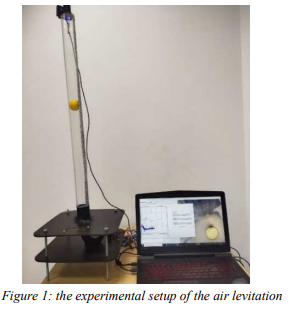
the proposed paper aims to design and model an air levitation system, which is a highly nonlinear system because of its fast dynamics and low damping. The system is trained using a Nonlinear Autoregressive model with exogenous input (NARX model). An enhanced height measurement system, modified setup, and several training techniques have been used to overcome the restrictions that the non-linearity of the system imposes in the literature. The system mathematical model has been illustrated, followed by an identified model using NARX model trained on several input-output data from the physical
Transmit and receive cooperative cognition: Protocol design and stability analysis
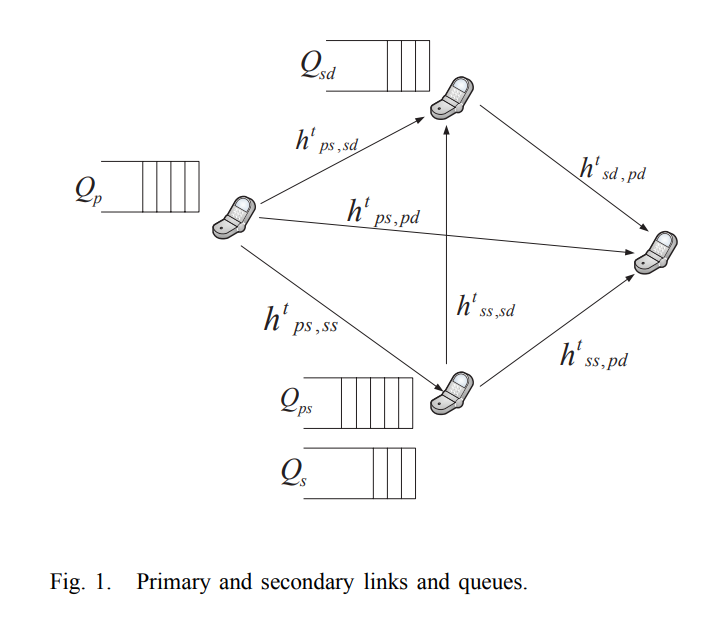
In this paper, we investigate the stability of a cooperative cognitive system. We propose a cooperative secondary transmitter-receiver system (CSTR), where, the secondary transmitter (ST) and the secondary receiver (SR) increase the spectrum availability for the ST packets by relaying the unsuccessfully transmitted packets of the primary transmitter (PT). We assume receiving nodes with multipacket reception capability (MPR). We provide two inner bounds and two outer bounds on the stability region of the considered system. © 2013 ICST - The Institute for Computer Sciences, Social Informatics
Theoretical and experimental investigation study of data driven work envelope modelling for 3D printed soft pneumatic actuators
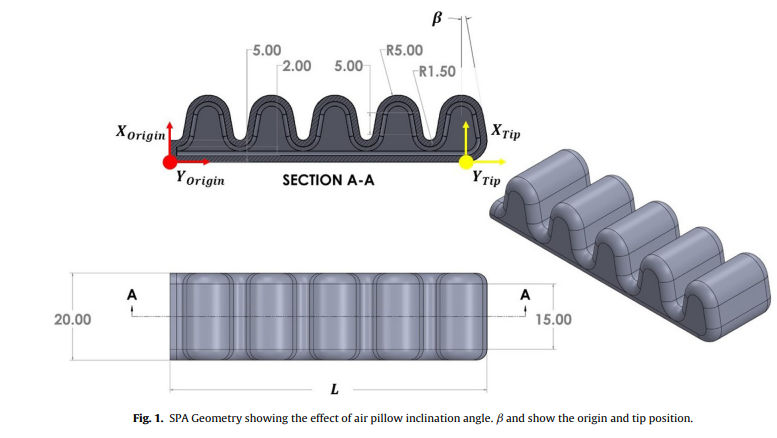
In the last decade, soft robotics is considered one of the most widely researched fields in robotics, as it has many advantages and more versatile use than rigid robotics. Soft robots are flexible, which enable them to metaphorically complex designs, enabling them to imitate the movement of living things. In this article, the use of regression models with finite element analysis (FEA) data is compared with neural network (NN) models trained on visual feedback data. The effect of the soft pneumatic actuator (SPA) air pillow inclination angle (β) under positive and vacuum pressure on the
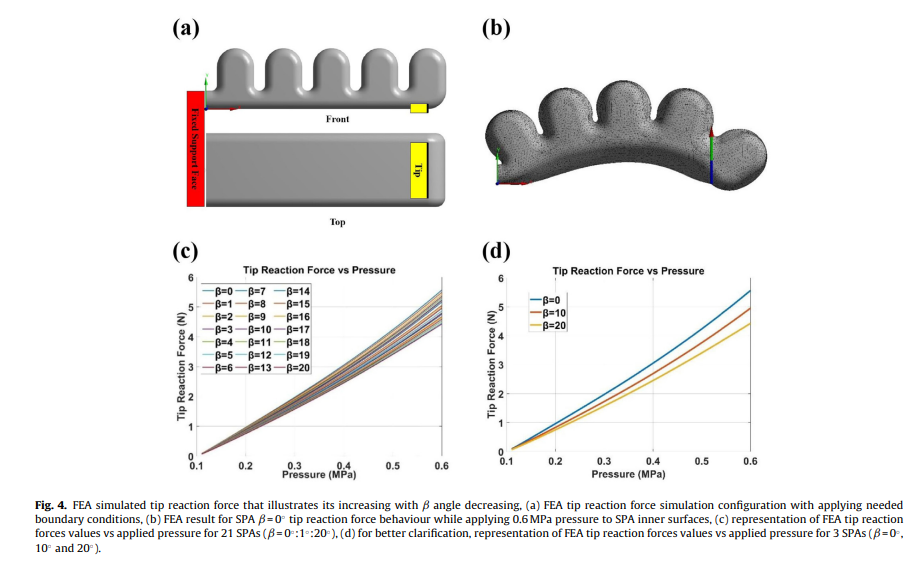
Design and implementation of variable inclined air pillow soft pneumatic actuator suitable for bioimpedance applications
The technological revolution has caused the modernization of human–machine relationship changing our approach in problem solving our society issues and deviated the science of robotic all together. An example for one of the most important pawn in this revolution is soft robotics, the soft robots are robots that are made of deformable materials that provide an alternative approach to rigid robots. The soft pneumatic actuator (SPA) is one of the most widely used and studied form of this type of robotics. In this study, a new geometrical parameter of the SPAs is introduced by studying the effect

Path Planning Control for 3-Omni Fighting Robot Using PID and Fuzzy Logic Controller
This paper addresses a comparison between some control methods of three Omni wheels firefighting robot due to the variety of maneuverability. To achieve path planning for firefighting robot to reach a specific point with the shortest path, a kinematics model of omni wheel robot is applied with some control algorithms based on PID controller, Fuzzy logic controller and self-tuned PID using fuzzy logic techniques. Hardware prototype has been tested to validate the simulation results. © 2020, Springer Nature Switzerland AG.